If you’ve ever visited a tunnel construction site, a slope stabilization project, or a mining operation, you’ve probably seen the thick, wet layer of concrete being sprayed onto surfaces at high speed—that’s shotcrete, and the machine behind it is the backbone of the whole operation. As someone who’s been selling shotcrete machines for over 12 years, I’ve lost count of how many times potential customers have walked into my showroom or sent an email asking the same question: “How do I calculate my shotcrete machine’s production rate?” It’s not a random number pulled out of thin air, and it’s not just about what the spec sheet says. It’s a mix of machine design, material prep, operator skill, and on-site conditions. Today, I’m breaking down exactly how to get that number right, because getting it wrong can cost you time, money, and even project delays. Shotcrete Machine
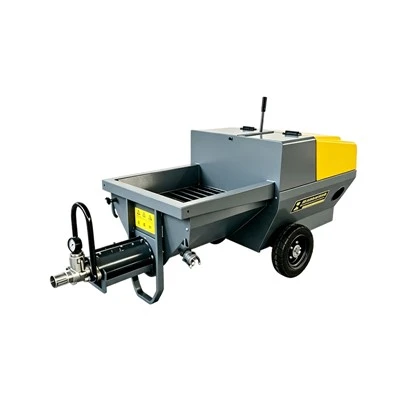
First, let’s start with the basics: what shotcrete production rate actually means. For my customers, it’s never just “how much concrete can the machine spray per hour.” It’s the volume of finished, applied shotcrete that makes it to the surface without wasting material, and without causing bottlenecks in the rest of the workflow. Some machine brands will list a “theoretical” output on their specs, like 6 cubic meters per hour, but that’s only if everything is perfect. In the real world, that number almost always comes down. I’ve seen a new machine from a top brand hit 5.2 cubic meters per hour on a well-prepped tunnel job, while a lower-cost model struggled to hit 3.5 on the same site. The difference isn’t the machine’s power—it’s how you measure, and adjust, the rate based on your unique setup.
The first step in calculating your production rate is figuring out your machine’s core mechanical output, often called “dry mix output” if you’re using dry shotcrete, or “wet mix output” if you’re using the wet process. Let’s split these two because they work very differently. Dry mix machines feed dry cement, aggregates, and admixtures into a mixing chamber, then add water at the nozzle. Wet mix machines pre-blend all the ingredients before pumping the mix to the nozzle.
For dry mix machines, the theoretical dry output is calculated by the machine’s air compressor capacity and the material hopper feed rate. Air pressure is what propels the dry mix through the hose, so if your compressor is only delivering 7 bar instead of the required 10 bar for your machine, your output drops by 15-20% right there. The hopper feed rate is another big one: if your operator can only feed 120 kg of dry mix per minute (because the hopper is too small, or the material is damp and clumpy), that’s 7.2 tons per hour, or roughly 5.8 cubic meters per hour for typical shotcrete mix (which has a density of ~1.2 tons per cubic meter). But if the mix is damp, clumping in the hopper, you might only be feeding 90 kg per minute, cutting that rate down to 4.3 cubic meters.
Wet mix machines are a bit simpler for core output, because the mix is already pre-blended. The theoretical output here is based on the pump’s flow rate, usually measured in liters per minute. For example, a standard wet shotcrete pump might have a flow rate of 100 liters per minute, which translates to 6 cubic meters per hour. But again, this is only if the mix is the right consistency—too thick, and the pump struggles; too thin, and you get sagging, which means you have to re-spray, wasting material and time. As a supplier, I always tell wet mix customers to test their mix’s slump before calculating: a slump of 8-10 cm is ideal, and if yours is off by even 2 cm, you can lose 10-12% of your output.
But here’s the part most customers miss: the mechanical output is just the start. The real-world production rate is slowed down by a handful of “human and material factors” that add up fast. Let’s walk through each of these because they’re the difference between a profitable job and one that eats into your budget.
First, material prep time. Shotcrete isn’t like ready-mix concrete you pour into a form; it has to be mixed consistently, and if you’re using a batch plant, that adds time. For example, if your batch plant can only mix 2 cubic meters of shotcrete every 10 minutes, that’s 12 cubic meters per hour of batch output, but if your shotcrete machine can process 6 cubic meters per hour, your total production rate is capped at 6 cubic meters per hour, because you can’t feed the machine faster than the batch plant can make the mix. I once had a customer who thought his machine could do 8 cubic meters per hour, but his batch plant was only doing 5, so he was waiting 30 minutes every hour for mix, dropping his actual rate to 4. That’s a $1,200 loss a day right there—just from not aligning the machine’s capacity with his batch plant’s.
Then there’s operator efficiency. I’ve seen two operators with the same machine get wildly different rates. A skilled operator knows how to move the spray nozzle in overlapping passes (so you don’t have to re-spray thin spots), adjust air pressure on the fly for different surfaces, and keep the hopper full without clogging the hose. A new operator might stop every 5 minutes to unclog a hose, which adds up to 20-30% lost time. Last year, a mining customer of mine hired a team of new operators and their production rate dropped from 5.1 cubic meters per hour to 3.7. We did a quick operator training session, and they were back up to 4.8 the next week. Skill matters more than most people realize.
Surface condition also plays a huge role. If you’re spraying on a rough, porous rock surface, you can spray thicker layers in one pass, which speeds things up. But if you’re spraying on a smooth, vertical concrete surface, you have to do thinner passes (2-3 cm each) to prevent sagging, so you can only add 4-5 passes per hour, instead of 8-10 on a horizontal surface. Slope stabilization projects, for example, often have uneven surfaces, so production rates are 10-15% lower than tunnel jobs, where surfaces are relatively uniform. I always tell customers to build a 10-15% buffer into their rate if their project has lots of irregular surfaces.
Waste is another hidden factor that people forget. Shotcrete waste comes from hose clogging, over-spray (material that bounces off the surface), and leftover mix at the end of a shift. For dry mix projects, over-spray can be 10-20%—meaning for every 10 cubic meters you “put through” the machine, only 8-9 actually stays on the surface. That’s why the theoretical output is never the same as the applied output. Wet mix has less over-spray (usually 5-10%), but leftover mix can add up if you’re not cleaning the pump properly at the end of each shift. As a supplier, I offer free waste audits to my customers, because cutting waste by even 5% can increase your production rate (and profit) without buying a new machine.
So how do you actually calculate your own rate, step by step, instead of relying on generic numbers? Let’s make a concrete example, using a wet shotcrete machine, since that’s the most common setup for tunnels and slopes.
- Start with your machine’s rated flow rate: Let’s say your wet shotcrete pump has a rated flow of 100 L/min, which is 6 m³/h. That’s your theoretical core output.
- Factor in material consistency: Your mix’s slump is 9 cm, which is perfect, so no loss here. If slump was 7 cm, you’d add a 10% deduction for pump drag, so 5.4 m³/h.
- Factor in batch plant output: Your batch plant makes 5.5 m³/h, so you’re capped at 5.5 m³/h here, which is lower than your machine’s capacity.
- Factor in operator skill: Your operators are mid-level, so add a 10% deduction for minor hose unclogs and passes, making it 4.95 m³/h.
- Factor in surface condition: Your project has vertical concrete walls, so add a 12% deduction for thinner passes, making it 4.35 m³/h.
- Factor in waste: Your over-spray is 8%, so your applied production rate is 4.35 * 0.92 = ~4 m³/h.
That’s your real, working production rate—almost 2 cubic meters less than the machine’s theoretical rating, but that’s normal. If you were using a dry mix machine, you’d adjust for air compressor pressure (if it’s 9 bar instead of 10, deduct 10%) and hopper feed rate (if damp mix slows you by 15%, add that deduction), then do the same steps for batch, operator, surface, and waste.
Now, a common mistake I see new customers make is buying a machine that’s too big for their project. Last year, a small construction company came to me looking for a shotcrete machine for a 500 m² slope stabilization job. They thought they needed a 10 m³/h machine to “keep up,” but their batch plant only did 4 m³/h. A smaller 5 m³/h machine would have been perfect, because a bigger machine would just mean they were waiting twice as often for mix, wasting money on a machine they didn’t need. The key is to match the machine’s capacity to your slowest link—batch plant, operator, surface, whatever that is.
Another thing to keep in mind: some projects use a combination of shotcrete and other materials, like fiber-reinforced shotcrete for mining. The fibers add a bit of drag to the mix, so your flow rate drops by 5-10%, which means you need to adjust your production rate accordingly. I always ask customers if they’re using fibers or admixtures when I help them calculate their rate, because that’s a quick variable that’s easy to miss.
If you’re still unsure about your production rate, here’s a simple test you can do on-site to get a real number. Pick a 1-hour window where everything is running smoothly—no delays, no mix issues, skilled operators, and a consistent surface. Measure how much applied shotcrete you put on the surface in that hour. Do this 3 times, average it out, and that’s your baseline rate. Then, you can adjust based on any factors specific to your project. For example, if your average is 4 m³/h, and your surface is 50% vertical, you know to plan for 3.6 m³/h when you’re working on vertical sections.
At the end of the day, calculating shotcrete machine production rate isn’t about pulling a number from a spec sheet. It’s about combining your machine’s capabilities with your site’s unique conditions, materials, and team. As a shotcrete machine supplier, I don’t just sell you a machine and walk away— I help you figure out exactly what capacity you need, so you don’t overspend on a machine that’s too big, or end up with one that can’t keep up with your project. If you’re planning a new job, or struggling with slow production rates on your current projects, reach out to us to talk through your setup. We’ll run through the numbers together, test your mix and machine, and make sure you get the production rate that works for you.
If you’d like to learn more about machine sizing, mix consistency, or operator training resources, feel free to contact us for a consultation.
Polyurea Spraying Machine References
- American Society of Civil Engineers (ASCE). “Shotcrete Practice Guidelines for Tunneling and Mining.” 2018.
- International Association of Shotcrete and Sprayed Concrete (IASSC). “Production Rate Calculation for Wet and Dry Mix Shotcrete Systems.” 2020.
- Concrete Construction Magazine. “Optimizing Shotcrete Production: Key Factors for Site Efficiency.” 2021.
Zhejiang Wengong Intelligent Technology Co., Ltd.
Zhejiang Wengong Intelligent Technology Co., Ltd. is one of the most professional shotcrete machine manufacturers and suppliers in China. With abundant experience, we warmly welcome you to buy durable shotcrete machine made in China here and get quotation from our factory. Quality products and reasonable price are available.
Address: No.111 Huakang Road, Liuao Village, Qiaoxia Town, Yongjia County, Wenzhou City, Zhejiang Province, China
E-mail: sales007@cngcjx.com
WebSite: https://www.wallgoe.com/
