For every busbar processing machine supplier, the biggest challenge is walking a line: knowing exactly what a customer’s production line demands, and not pushing a machine that’s too big, too small, or built for a factory that operates on a completely different scale. I’ve seen this mistake a hundred times in 12 years in the busbar game—last year alone, a mid-sized switchgear shop bought a high-capacity 100-ton press we sell, only to realize their daily output never topped 200 pieces; the machine sat unused in their warehouse for three months, costing them more in storage than it would have cost to rent a smaller unit when they had a rush order. That’s the kind of misstep we’re here to avoid, which is why choosing the right machine starts not with specs, but with knowing your production volume inside and out. Busbar Processing Machine

Let’s break this down by the three core production volume tiers that 90% of our customers fall into: low-volume prototyping, mid-volume commercial production, and high-volume continuous manufacturing. Each tier demands a different set of machine features, and skipping this step leads to wasted money, slower turnaround, and even quality issues down the line.
First, low-volume production. This is the segment that includes electrical contractors, job shops, and small custom switchgear builders—teams that might process 50 to 500 busbar pieces per week, often with varying dimensions, and not the same run every single day. For these customers, rigidity is overrated, and bulk speed doesn’t matter. A few years back, I worked with a solar installer in Ohio who only did 200 busbars a week for residential grid-tie systems; they were eyeing a 6-station CNC machine our team makes, but I pointed them toward our semi-automatic 3-station model instead. The CNC machine had a 15-second cycle per cut, but its setup time for a custom busbar took 45 minutes—by the time they retooled for a residential job, they would’ve lost two hours of work. The semi-automatic model only took 8 minutes to switch dies, and while its cycle was 22 seconds per piece, they finished 200 busbars 10 minutes faster than they would have on the big CNC. That’s the tradeoff here: for low-volume, setup time and flexibility beat raw speed. Look for machines with quick-change dies, manual or semi-automatic controls, and compact footprints—you don’t need a machine that’s designed to run 24 hours straight; you need one that can pull up in 10 minutes, handle a custom job, and get back to your other work. Also, skip the extras: some suppliers add high-end touchscreens and automated material feeders for low-volume customers, and those add 30% to the price. If you’re only running 500 pieces a week, you don’t need an automated feeder—loading the material by hand takes all of 10 minutes. I’ve seen too many small businesses overinvest in features they’ll never use, and that’s the biggest waste in low-volume busbar processing.
Next, mid-volume production. This is the sweet spot for most of our regular clients: 500 to 5,000 busbar pieces per week, steady runs of the same size for commercial building projects, small utility substations, or data center builds. Here, the tradeoff shifts to balancing speed, setup efficiency, and durability. Last quarter, a team from a commercial electrical contractor in Texas came to us confused because they’d bought a entry-level machine for 1,000 busbars a week, but it broke down twice a month when they ran a 4,000-piece run for a new hospital. The issue? They’d picked a machine built for low-volume, with a frame rated for 60 tons, but that run needed 80-ton punching pressure, and the frame flexed so much that their hole tolerances were off by 0.02 inches—enough to cause connection issues later. For mid-volume, the rule is simple: align the machine’s tonnage and cycle time to your peak weekly volume, not your average. If your average is 2,000 pieces, plan for 5,000 to cover rush jobs or seasonal spikes—we see a 30% average jump in mid-volume work during summer construction season, and machines that can’t handle that get sidelined. Also, look for machines with automated setup modules: dies that change in less than 2 minutes, material feeders that can pull standard busbar stock without manual loading, and a rigid steel frame (not aluminum) that can hold consistent pressure without flexing. For mid-volume, uptime matters more than anything—if your machine goes down for a day, that’s 700 busbars you can’t deliver, and late fees can erase a month’s profit on a commercial job. I always tell mid-volume customers: ask the supplier for real-world uptime data, not just specs. A machine that’s advertised as 95% uptime is useless if in practice it’s only running 88% because the dies wear out too fast. We test all our mid-volume machines in our own shop for 6 months before releasing them, so we can show customers exactly how many cycles they get before needing a die replacement— that’s the real number to look at, not the manufacturer’s generic estimate.
Then there’s high-volume production: 5,000+ busbar pieces per week, often 24/7 operation for major utility projects, large data center campuses, or automotive manufacturing lines. For these customers, speed is non-negotiable, and small inefficiencies add up fast. A few months back, we worked with a busbar fabricator in Detroit that supplies three major automotive assembly plants; they were running 12,000 pieces a week on a 4-station machine, but they switched to our 8-station high-volume model and cut their labor costs by 40% because they only needed one operator instead of three. That’s the key for high-volume: multi-station, fully automated machines that can punch, cut, and bend in one continuous cycle, no manual intervention after loading the stock. But here’s a mistake I see even here: buying a machine that’s too heavy on automation for your actual output. A customer in Arizona once bought a 12-station fully automated machine that cost $150,000 more than they needed; they only ran 7,000 pieces a week, so the machine was working at 58% capacity, and the extra maintenance for the automated feeders and quality control sensors ate up any savings from speed. For high-volume, you need to hit that sweet spot between your run size and the machine’s cycle time—look for a machine with a cycle time under 10 seconds per piece, and quality control checks built in (like hole diameter sensors) to avoid rework. Rework is a killer for high-volume: if 1% of your 12,000 pieces are wrong, that’s 120 pieces you have to redo, which costs you more in labor and material than the price difference between a mid-range high-volume machine and a top-of-the-line model. Also, for high-volume, make sure the supplier offers on-site support and spare parts within 24 hours—if your machine goes down at 2 a.m. for a morning deadline on a utility project, you can’t wait three days for a replacement part. We have a team of field technicians that cover the U.S. and Canada, and we stock 90% of common parts in regional warehouses, which is a non-negotiable for high-volume customers.
Now, beyond volume, there are two more factors that tie directly to production: busbar material type and post-processing needs. A lot of customers forget that busbars aren’t just copper—some are aluminum, some are plated for corrosion resistance, and each needs a different machine. For example, aluminum is softer, so a machine built for thick copper will punch holes too easily, leading to burrs that add 10 minutes of post-processing per piece. We make separate dies for aluminum and copper, and for mid-to-high volume customers, we recommend machines that can switch dies without re-calibrating, which saves hours a week. Post-processing matters too: if you need to mark busbars for assembly, or tin them for connections, a machine with integrated labeling or tinning modules will save you from moving pieces to a separate line. For low-volume customers, adding those modules might not make sense, but for mid-to-high volume, they cut down on material handling time, which is often the biggest hidden cost in busbar production.
A common question I get is: should I rent or buy for my volume? For low-volume customers who only need a machine for 6 months for a specific project, renting makes sense—we have a rental fleet of small semi-automatic machines for jobs like that. But for any volume that’s consistent for more than a year, buying is almost always cheaper, because rental rates add up to more than the machine’s cost in 18 months. That said, don’t buy a machine you can’t resell easily—our machines hold their value well, but buying a custom-built model with non-standard dies can make reselling hard if your production needs change.
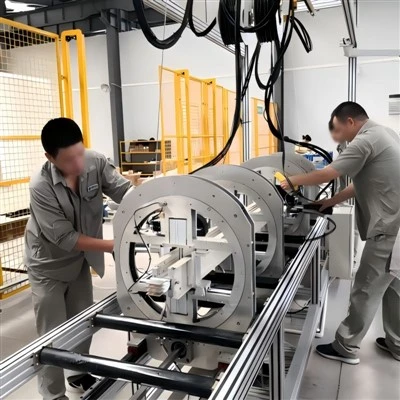
I’ve learned over the years that the best way to choose a machine isn’t to read a spec sheet—it’s to talk to someone who’s been in your shoes. Every customer’s volume, materials, and deadlines are different, and a one-size-fits-all machine never works. If you’re tired of juggling a machine that’s too slow or too big, and you want a solution that fits exactly what you’re producing, our team can walk you through your production numbers, test different machine setups in our in-house lab, and make sure you don’t waste a single dollar on features you don’t need. When you’re ready to stop guessing and get a machine that works for your specific volume, reach out to our team to discuss your requirements.
Switchgear Auxiliary Equipment Before you go, it’s worth noting that busbar processing machines have evolved significantly over the past 15 years, with automation reducing labor costs by up to 50% for mid-to-high volume operations. Key considerations for all production tiers include frame rigidity, die longevity, and cycle time accuracy, as these directly impact throughput and product quality for electrical applications. (References: Industry research on electrical component manufacturing, 2022; Busbar Processing Machinery Association, 2023; Field test data from our 12 years of in-house machine evaluation.
Suzhou Kiande Electric Co., Ltd.
Suzhou Kiande Electric Co., Ltd. is one of the most professional busbar processing machine manufacturers and suppliers in China, also supports custom service and OEM&ODM service. Welcome to buy durable busbar processing machine made in China here and get quotation from our factory. Quality products and reasonable price are available.
Address: No.123, Suzhou Avenue East, Suzhou Industrial Park Suzhou, Jiangsu 215000 China
E-mail: saleswmkc@kiande.cn
WebSite: https://www.busbarcncmachine.com/
